

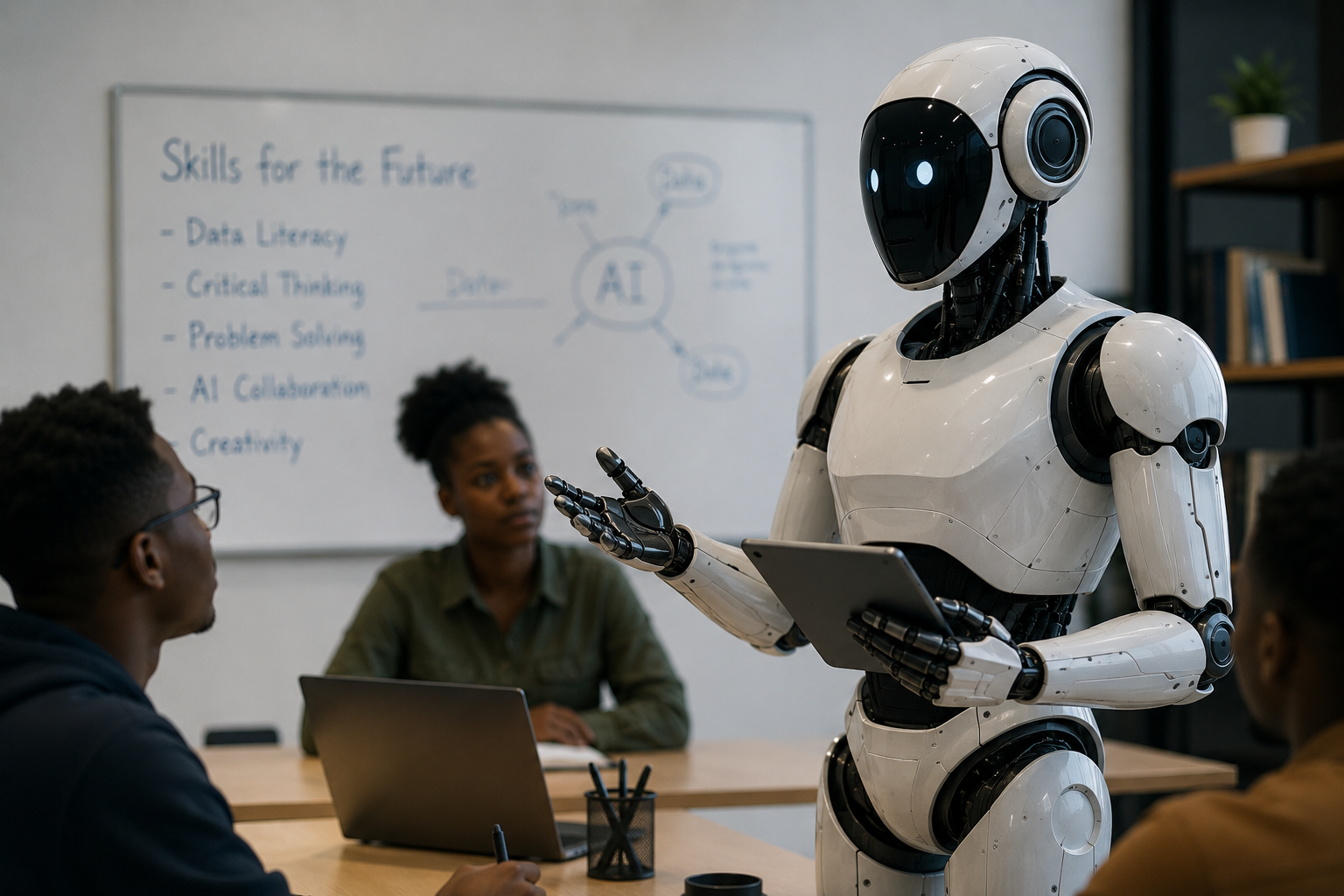
AI Just Got a Body. Here’s Why That Changes What’s Worth Learning
For years, AI mostly lived inside a screen. It answered questions, wrote text, sorted data. It didn’t pick things up, walk across a room, or fix something on a shelf.
That’s changing quickly. Industry analysts are calling this the breakout moment for Physical AI, AI that doesn’t just process information, but senses, moves, and acts in the real, physical world. Warehouses, factories, and logistics companies are moving robots out of pilot programs and into everyday, real production use.
What’s actually driving this shift
A few things have come together at once. Robots can now be trained in realistic computer simulations before ever touching a real object, which makes learning new tasks dramatically faster and cheaper. Cameras and sensors have gotten good enough that robots can understand an unfamiliar space, not just follow a fixed, pre-programmed path. And the cost of building a capable robot has dropped fast enough that it’s no longer only huge corporations experimenting with this technology.
Why this isn’t just a factory story
It’s easy to picture this as something happening far away, in car plants and warehouses most of us will never see. But underneath the humanoid robots and headline demos are a set of concrete, learnable engineering skills that show up everywhere robotics is used, from industrial arms to drones to simple automated systems.
The skills behind the headlines
Kinematics and dynamics. The math behind how a robot’s joints and limbs move, and how forces act on them while they do.
Control systems. The logic that keeps a robot’s movements accurate, stable, and safe, rather than jerky or unpredictable.
Sensor integration. Combining cameras, distance sensors, and other inputs so a robot actually understands what’s around it.
Autonomous navigation. Letting a robot move through a space on its own, adjusting as it goes, instead of following one fixed route.
Machine learning applications. The layer that lets a robot improve at a task over time, rather than only ever doing exactly what it was originally programmed to do.
None of these are new, futuristic mysteries. They’re established engineering disciplines that have simply become far more valuable now that the industry actually has the computing power and sensors to put them to full use.
Who this is genuinely useful for
This field isn’t limited to one type of student:
Mechanical and electrical engineering students, who’ll find robotics is where their core subjects meet real, tangible machines.
Computer science students, who bring the programming and machine learning side of things.
Tech enthusiasts and career changers, who want hands-on experience in a field that’s clearly still early, with real room to grow into it.
Getting hands-on, not just theoretical
Reading about robotics and actually building, wiring, and programming one are very different experiences. The gap between the two is exactly where real skill gets built.
Our Robotics course covers kinematics, dynamics, control systems, sensor integration, and machine learning applications through genuinely hands-on work, designing, building, and programming real robots, so you come away with skills that go well beyond theory.
Curious what it actually takes to build a robot, not just watch one on the news? Explore Our Robotics course and get hands-on with a field the whole tech world is watching right now.